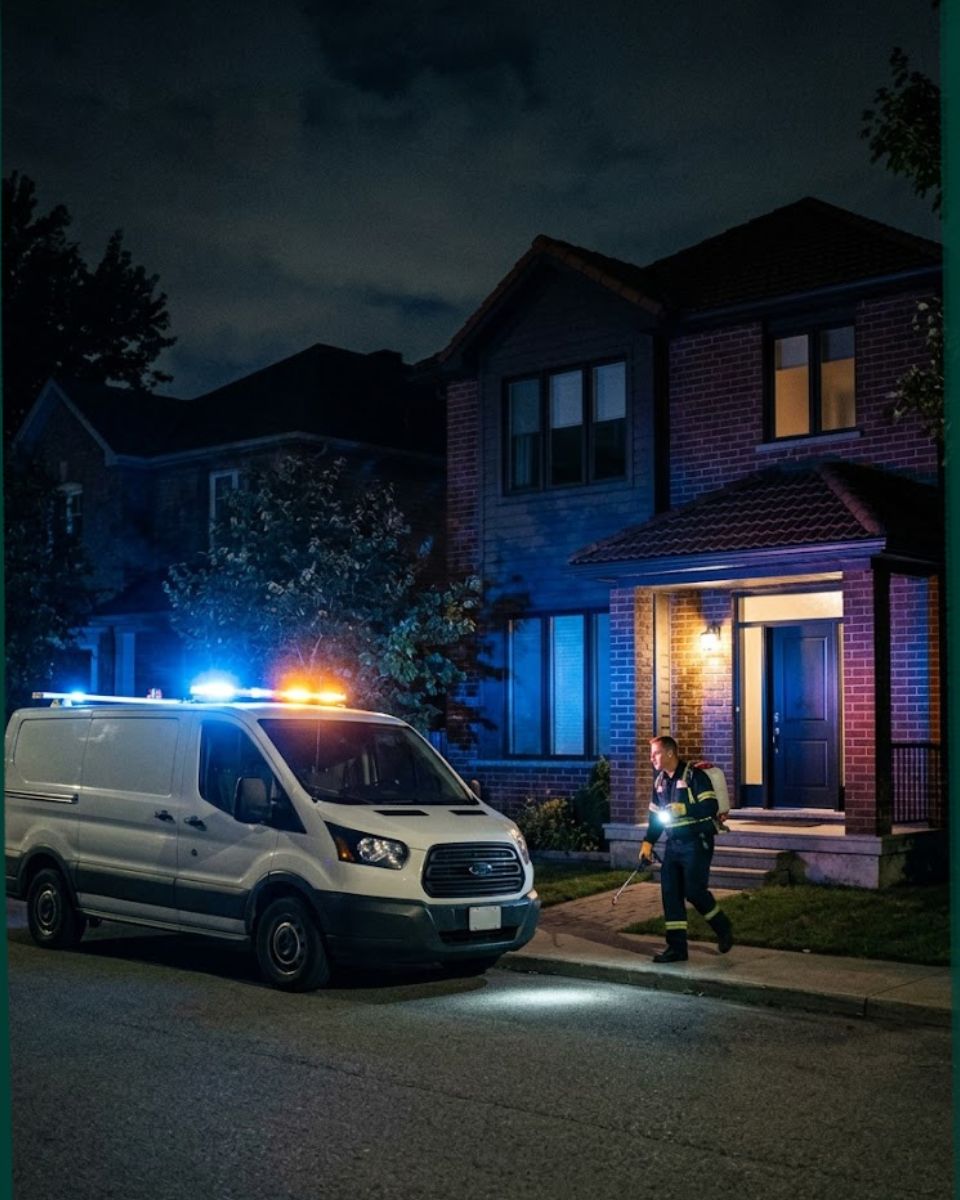
What actually counts as a rodent emergency
Most rodent activity isn’t a same-day emergency. Suspected attic activity, occasional droppings in a single location, sounds at night, prevention planning — these are situations where scheduling within a few days is appropriate, and rushing the response often costs more without solving the problem faster. The key question for emergency status is whether the situation will get meaningfully worse within hours or whether it can wait.
Genuine rodent emergencies fall into a few specific categories. Live rats or mice visible inside the living area, particularly multiple sightings within hours, indicate an active intrusion that warrants prompt response before the population establishes. Dead-rodent smell that’s acute enough to disrupt living conditions needs same-day removal because the smell intensifies over 4–10 days before fading. Business properties facing imminent health-department inspection or customer-visible rodent activity need same-day response to limit business impact. Healthcare facilities with active rodent presence in patient areas need same-day response for compliance reasons.
Restaurant and food-service emergencies
Restaurants face the most acute rodent emergencies because of health-department implications. A health inspection finding active rodent activity can result in immediate closure orders, particularly if customers or staff have observed rodents on premises. Same-day response in these situations involves rapid inspection, immediate exclusion of accessible entry points, station deployment, and documentation suitable for the health department visit.
The challenging dynamic in restaurant emergencies: the rodent problem often develops over weeks or months before discovery, but the response window is typically hours. Same-day work addresses immediate visible activity but doesn’t replace the longer-term program needed to actually resolve the underlying infestation. Restaurant operators sometimes treat the same-day response as the full solution, which leaves the underlying problem unaddressed.
Dead-rodent removal — why it’s usually same-day
Dead-rodent removal is one of the most common same-day calls in Savannah because the smell is genuinely acute and Coastal Georgia humidity accelerates decomposition. A dead rat in a wall in August produces aggressive odor within 24–48 hours of death; peak intensity hits at days 4–10 and fades over 2–6 weeks if not removed. Most homeowners can’t tolerate the smell that long, particularly in occupied living spaces.
Same-day dead-rodent removal involves scent triangulation to narrow the carcass location, scope camera inspection through existing access points where possible, targeted access (typically 4–6 inch hole) when wall cutting is needed, removal with PPE, sanitization of the immediate area, and identification of the entry route the rodent used so it can be sealed against recurrence.
Active infestation discovery — when fast response actually helps
Discovering active rodent presence (live rodents in living areas, fresh droppings on food-prep surfaces, active gnaw damage in occupied rooms) warrants same-day response specifically because the situation is at the early-establishment stage where fast intervention prevents population expansion. Waiting two weeks while a small initial population expands typically converts a 3-week treatment program into a 5–6 week program.
Same-day response for active discovery involves rapid inspection and trapping deployment to prevent further population establishment, identification of likely entry points for prompt sealing, and scheduling of follow-up exclusion work within days rather than weeks. The full treatment program still takes its normal duration, but the early intervention prevents the situation from worsening during the gap.
Healthcare facility emergencies
Healthcare facilities have specific same-day response requirements because of patient safety and compliance implications. Active rodent presence in patient areas, food preparation zones, or pharmacy storage requires immediate removal and documentation suitable for incident reporting. Joint Commission and DHEC standards generally expect documented rapid response to any active rodent event at accredited facilities.
Same-day healthcare response involves discreet rapid dispatch (to limit patient and visitor visibility of pest-control activity), immediate isolation of the affected area where possible, rapid removal and documentation, and after-incident reporting suitable for compliance binders. The longer-term program adjustment happens in follow-up visits rather than the emergency response itself.
What you should expect from emergency response
Emergency response in Savannah should arrive within 2–4 hours of the call during operating hours (9AM–9PM) for most addresses, and within 1–3 hours for downtown and central Savannah addresses. Adjacent-county addresses (Pooler, Richmond Hill, Tybee Island) may take 30–60 minutes longer because of drive time. After-hours emergency response (outside the 9AM–9PM window) varies by provider; some Savannah providers do 24/7 emergency response with after-hours fees, others limit to operating hours.
Pricing for emergency response typically includes a same-day or after-hours fee on top of the standard work scope. Reasonable same-day fees in Savannah run $75–$150 above standard pricing; after-hours fees can run $150–$300 above standard. Providers charging substantially more for emergency response are typically pricing for the urgency rather than the actual additional cost.
What shouldn’t be an emergency
A few situations get treated as emergencies but really shouldn’t be. Single mouse sightings without other evidence of established population — DIY snap trap response is appropriate before paying emergency fees. Attic scratching sounds with no urgency to the homeowner — schedule within the week rather than rushing. Suspected activity based on smells alone without other evidence — schedule inspection, don’t pay emergency response fees for diagnostic work.
Treating non-emergencies as emergencies usually costs more without solving the problem faster. The same-day arrival window often produces the same treatment scope as the next-week inspection would have produced; the work just costs more because of the rush.
What to tell us when you call — information that speeds up emergency dispatch
The quality of information you provide on the call directly determines how quickly we can get to you and what we bring. A call that says “I think I have a rat” takes longer to dispatch than one that provides specific details that let us load the right equipment and prioritize correctly.
Tell us: what you’ve seen or heard (live rodent, droppings, sounds, smell), where in the property (attic, kitchen, wall, restaurant kitchen), how long you’ve been aware of it, and what type of property it is (single-family home, restaurant, rental unit with guests). If it’s a business call, tell us whether there’s a health inspection, event, or guest arrival with a specific deadline.
For dead-rodent calls specifically, the location matters most: wall cavity versus attic floor versus crawl space require completely different access approaches, and knowing in advance what we’re likely dealing with lets us bring thermal imaging equipment for wall cavity cases or the appropriate PPE for attic scenarios. “Smell is coming from the wall behind the refrigerator in the kitchen” is much more actionable than “there’s a bad smell.”
What happens in the first two hours of an emergency response
When a technician arrives for an emergency call, the first 15–20 minutes are diagnostic: a walk-through of the reported area, a species and severity assessment, and a quick building-perimeter check if a live infestation is reported. This information determines the treatment approach for that visit.
For live-rodent emergencies, the first visit establishes snap traps in the active areas, identifies the primary entry points (which may be sealed on the same visit if accessible and time permits), and sets the expectations for the follow-up timeline. In restaurant emergencies, a written inspection report documenting findings and corrective actions taken is generated on the same visit for health department documentation.
For dead-rodent emergencies, the first visit focuses entirely on location and removal. If the carcass is accessible (attic floor, crawl space, behind an appliance), removal and odor treatment happen in the first visit. If it’s in a wall cavity requiring thermal imaging, that imaging happens in the first visit and either confirms access for immediate removal or schedules the wall-opening work for a follow-up. In most Savannah residential cases, a same-day emergency call results in the problem being substantially addressed within 2–3 hours of arrival.
How to prepare your property for the emergency technician’s arrival
The 20–30 minutes between your call and the technician’s arrival can be used productively. You don’t need to do anything with the rodent evidence itself — leave it in place so the technician can assess it in context. But a few small actions help the visit go faster and produce a more thorough result.
Unlock or make accessible any areas mentioned on the call: the attic hatch if attic sounds were reported, the crawl space access door if crawl space activity is suspected, and the relevant kitchen or utility areas if interior evidence was found. Move any items blocking access to under-sink cabinet interiors or behind the refrigerator if those are the reported locations.
If the emergency is at a commercial property — a restaurant, rental unit with guests, or healthcare facility — notify relevant staff so the technician can access back-of-house areas without interruption. For restaurant emergencies specifically, having a designated staff member who can escort the technician through the kitchen without disrupting service saves time and ensures nothing is missed.
Need help with rodents in Savannah?
Same-day inspection, locally owned, 90-day exclusion warranty across Chatham, Effingham, Bryan, and Liberty Counties.
📞 Call (912) 305-0115Related reading and services
Related blog posts: infestation signs · ultimate 2026 guide · pricing guide.
Related services: emergency rodent removal · same-day rat removal · dead rodent removal.