Droppings — the most reliable indicator
Droppings are the most consistent evidence of rodent activity and the fastest way to confirm species. Fresh droppings are dark, moist, and shiny; older droppings are dry, dull, and crumble when touched. Quantity and location both tell you something about the infestation scope.
House mouse droppings are tiny — about 1/8 inch, the size of small grains of rice, with pointed ends. They typically appear scattered across surfaces, in drawers, along baseboards, and under sinks. A single mouse can produce 50–75 droppings per day, so even a small infestation generates substantial dropping accumulation within a week.
Roof rat droppings are medium-sized — about 1/2 inch, similar to coffee beans, with pointed ends. They typically appear in attics, on top of insulation, along ceiling joists, and in upper-floor concealed spaces. A single roof rat produces 30–50 droppings per day; established attic populations leave hundreds in a few weeks.
Norway rat droppings are large — about 3/4 inch, blunt-ended (like olive pits). They typically appear in crawl spaces, near foundations, in basements, and along ground-level runways. Heavy concentrations near exterior foundation walls usually indicate active burrows nearby.
Sounds — what they mean and what they don’t
Scratching in the attic at dusk and dawn is one of the most distinctive rodent sounds. Roof rats are most active at these crepuscular hours, and the sound is typically rhythmic scratching against wood or insulation rather than the louder thumping of larger animals. Persistent attic scratching almost always indicates rodent activity.
Scuttling in walls at night usually indicates rodents traveling between floors via stud cavities. Mice produce light, fast scuttling; rats produce heavier sounds. The location of the sound (which wall, which floor) tells you about the travel route they’re using.
Loud thumping or running above ceilings during daytime is usually not rodents — it’s more likely raccoons, squirrels, or possums (wildlife, which is outside our scope; for those, a wildlife control operator is the right call). Rodents are predominantly nocturnal; daytime activity at high volume is a wildlife indicator.
Vocalizations (chittering, squeaking) sometimes indicate rodents, particularly during nesting periods or territorial disputes. Mouse vocalizations are higher-pitched and quieter; rat vocalizations are lower and louder. Most homeowners don’t hear vocalizations from established populations because the rodents avoid drawing attention.
Smells — what does rodent infestation actually smell like?
Active rodent populations produce a distinctive musky smell, particularly from urine accumulation in concealed spaces. The smell is often described as ammonia-like or musky-pungent, and it intensifies in humid conditions (which describes most of Savannah’s year). Strong rodent smell in a specific area of the house usually indicates a nesting site or heavy travel route.
Dead-rodent smell is much more acute — sharp, aggressive, distinctly different from active-population smell. A dead rodent in a wall or attic produces unmistakable odor that’s typically peak intensity at days 4–10 after death and fades over 2–6 weeks if not removed. In Coastal Georgia humidity, the smell is particularly aggressive.
If you’re smelling persistent ammonia or musk without seeing other evidence, an attic or crawl-space inspection is worthwhile — the source is often visible once you look. If you’re smelling decomposition, dead-rodent removal is typically a same-day service call (we cover this separately).
Gnaw marks and physical damage
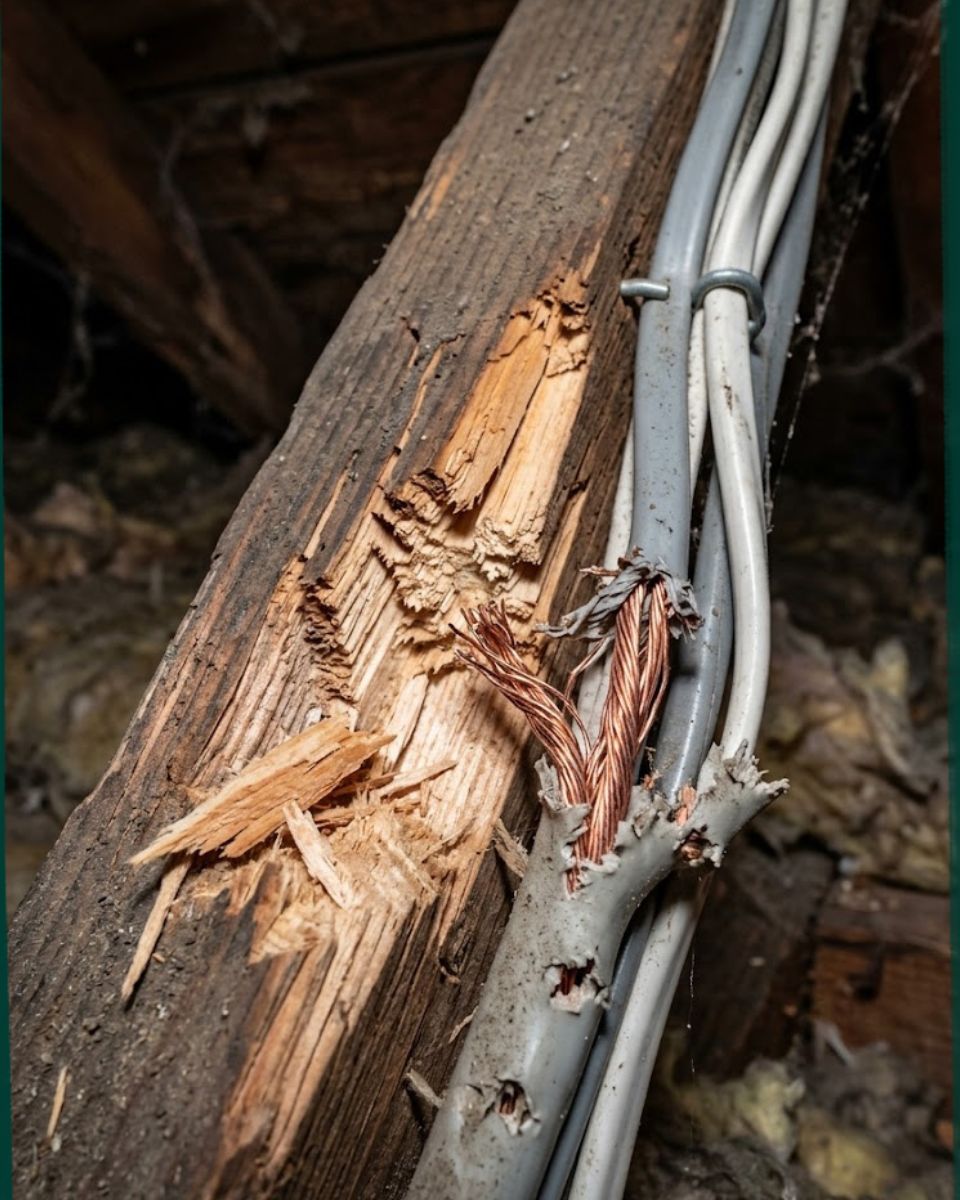
Rodents need to gnaw to keep their teeth from growing too long, and they gnaw constantly. Fresh gnaw marks are light-colored and have visible tooth striations; older gnaw marks darken with age. Common targets in Savannah homes: pipe lagging, wire insulation, structural wood at corners, stored food packaging, plastic storage bins, weather stripping around doors, and HVAC ducting.
Wire damage is one of the most consequential — chewed wire insulation creates fire risk and is a frequent insurance-claim trigger when fires occur. Periodic checks of wire runs in attics and along basement ceilings catch this before it becomes a problem.
Damage to wooden structural elements (joists, sill plates, framing) typically indicates established Norway rat populations. Fresh damage on these elements is a serious indicator that warrants prompt response.
Runways, smudge marks, and nesting evidence
Rodents are creatures of habit — they travel the same routes repeatedly. Over time, oil and dirt from their fur create dark smudge marks along walls, beams, and pipes at runway locations. These smudges are particularly visible along baseboards, around pipe penetrations, on attic joists, and along crawl-space sill plates.
Rodent runways through insulation appear as flattened or compressed tracks in attic blown-in. Fresh runways are crisp; older runways become disrupted as insulation settles back into place. Multiple parallel runways in the same area indicate established population travel.
Nests are typically built in concealed locations — wall voids, attic insulation pockets, crawl-space corners — and made of shredded material (paper, fabric, insulation, plastic). Finding a nest typically means there’s breeding activity at that location, which warrants prompt response.
What to do next
If you’ve identified one or two minor signs (occasional droppings in a single location, an isolated gnaw mark), DIY response is reasonable — snap traps, sealing visible entry points, monitoring for two to three weeks. If activity continues or worsens, escalate to professional inspection.
If you’ve identified multiple signs (droppings in several locations, sounds at night, smudge marks on baseboards), professional inspection is the right call. Multiple signs typically indicate established activity that DIY work won’t fully resolve.
If you’ve identified active or established rat activity (large droppings, runway evidence, structural damage), professional treatment is the appropriate response. Rat work consistently outperforms DIY attempts because of population dynamics and the regulatory restrictions on effective rodenticides.
Inspection-only service is available for situations where you want a professional opinion without committing to treatment. Useful for pre-purchase due diligence, insurance documentation, or when you’re uncertain about what the signs mean.
Signs by location — what to look for in each part of the house
Attic: Disturbed or compressed insulation (rodents nest in it and create runways through it), visible droppings concentrated along joists and rafters, gnaw marks on wood framing and wire insulation, and grease smears along rafters where roof rats travel regularly. Roof rat droppings in the attic are pointed at both ends and roughly 12–13mm long.
Kitchen and pantry: Small droppings (3–6mm for mice, 12–20mm for rats) near appliances, in cabinet corners, and behind the refrigerator. Gnaw marks on food packaging — mice chew small clean holes; rats tear through more aggressively. Grease marks along the base of cabinets where rodents travel the same path repeatedly.
Crawl space: Norway rat burrows near foundation walls and piers, disturbed vapor barrier, droppings concentrated near utility penetrations (plumbing, HVAC lines), and the characteristic musty ammonia smell of a large active population. Norway rat droppings are blunt-ended capsules, significantly larger than mouse or roof rat droppings.
Garage: Chewed cardboard and insulation used for nesting material, droppings near the garage door corners (a common entry point), and stored items disturbed or gnawed. Garages adjacent to the house with an interior door are a frequent entry pathway — rodents use the garage as a staging area before accessing the home.
How to assess severity from what you’re seeing
The number of droppings is the most reliable proxy for population size. A single mouse produces 40–100 droppings per day. If you’re finding fewer than 20 droppings total in a space, you likely have a recent or low-level incursion — early stage, responsive to targeted trapping. If you’re finding droppings in multiple rooms, or counts in the hundreds, you have an established population that requires more intensive treatment.
Freshness of droppings matters. Fresh droppings are dark, moist, and have a sheen. Older droppings dry to a lighter grey or brown and crumble when touched. If you find both fresh and old droppings, the infestation has been active for a while, which increases the likelihood of nesting, secondary damage (gnawed wires, contaminated insulation), and population growth.
Sound frequency and timing: occasional scratching that stops quickly suggests a recent explorer; rhythmic movement sounds in the same location every night for several nights indicates an established runway. Heavy thudding and rapid movement across the attic ceiling at dusk and dawn is the classic roof rat signature — they’re larger than mice and significantly louder.
What NOT to do when you first discover signs
Don’t seal entry points immediately. The impulse to block every gap you find makes sense, but if you seal an active population inside, you end up with dead rodents in your walls — a smell problem that can persist for weeks and requires wall-cavity access to resolve. Seal after the population is cleared, not before.
Don’t use poison bait blocks indiscriminately indoors. Consumer rodenticide blocks placed in open areas (not in tamper-resistant stations) are a secondary poisoning risk to pets and children. They also cause rodents to die in hard-to-reach locations, creating the same dead-rodent smell problem. Snap traps placed correctly are more effective and don’t create this issue.
Don’t assume one treatment is enough for an established population. A single snap trap or a single bait station visit won’t collapse a population that has been building for months. Effective treatment requires sustained pressure over 10–14 days minimum, combined with exclusion to prevent reinfestation.
Don’t ignore the evidence and wait. Rodent populations double roughly every 3–4 weeks under favorable conditions. Savannah’s year-round mild climate means there’s no cold-weather die-off that would naturally reduce a population. A small problem in October becomes a large and expensive problem by December.
Same-day emergency vs. scheduled appointment — how to decide
Call for same-day service if: you have a live rodent visible in your kitchen or a room your family occupies, you have a rental guest arriving within 48 hours, you’ve failed a restaurant health inspection for rodent evidence, or you’re smelling a dead rodent in a wall and it’s been more than 2 days. These are situations where delay compounds the problem or creates business liability.
Schedule a routine appointment if: you’ve found droppings but haven’t seen live rodents, you’re hearing sounds in the attic or walls but the activity is occasional rather than nightly, or you’re doing a preventive inspection because you’ve had past issues. These situations benefit from a thorough inspection rather than a fast response, and scheduling allows for better technician availability and time to conduct a complete assessment.
The cost difference: same-day emergency service in Savannah typically carries a premium of $75–$150 over standard scheduling. For genuine emergencies, that premium is worth it. For situations where the problem has been building for weeks, the same-day premium buys you speed but not a better outcome than a scheduled thorough inspection the next day.
Documenting evidence before your inspection — what helps technicians
If you have time before a scheduled inspection, photograph what you find. Photos of droppings in situ (before you clean them) give the technician critical information about where activity is concentrated, how fresh the evidence is, and whether the location pattern suggests a runway versus a random scatter. Photos of gnaw marks help confirm species when the animal hasn’t been directly sighted.
Note when you hear sounds and for how long. “Scratching in the ceiling above the master bedroom, 10 PM to midnight, every night for the past 5 days” is significantly more useful to a technician than “we hear something at night.” The timing, location, duration, and frequency of sounds are all diagnostic inputs that help focus the inspection on the right areas.
Need help with rodents in Savannah?
Same-day inspection, locally owned, 90-day exclusion warranty across Chatham, Effingham, Bryan, and Liberty Counties.
📞 Call (912) 305-0115Related reading and services
Related blog posts: 2026 ultimate guide · rats vs mice · attic & crawl space.
Related services: rodent inspection · rodent removal · dead rodent removal.