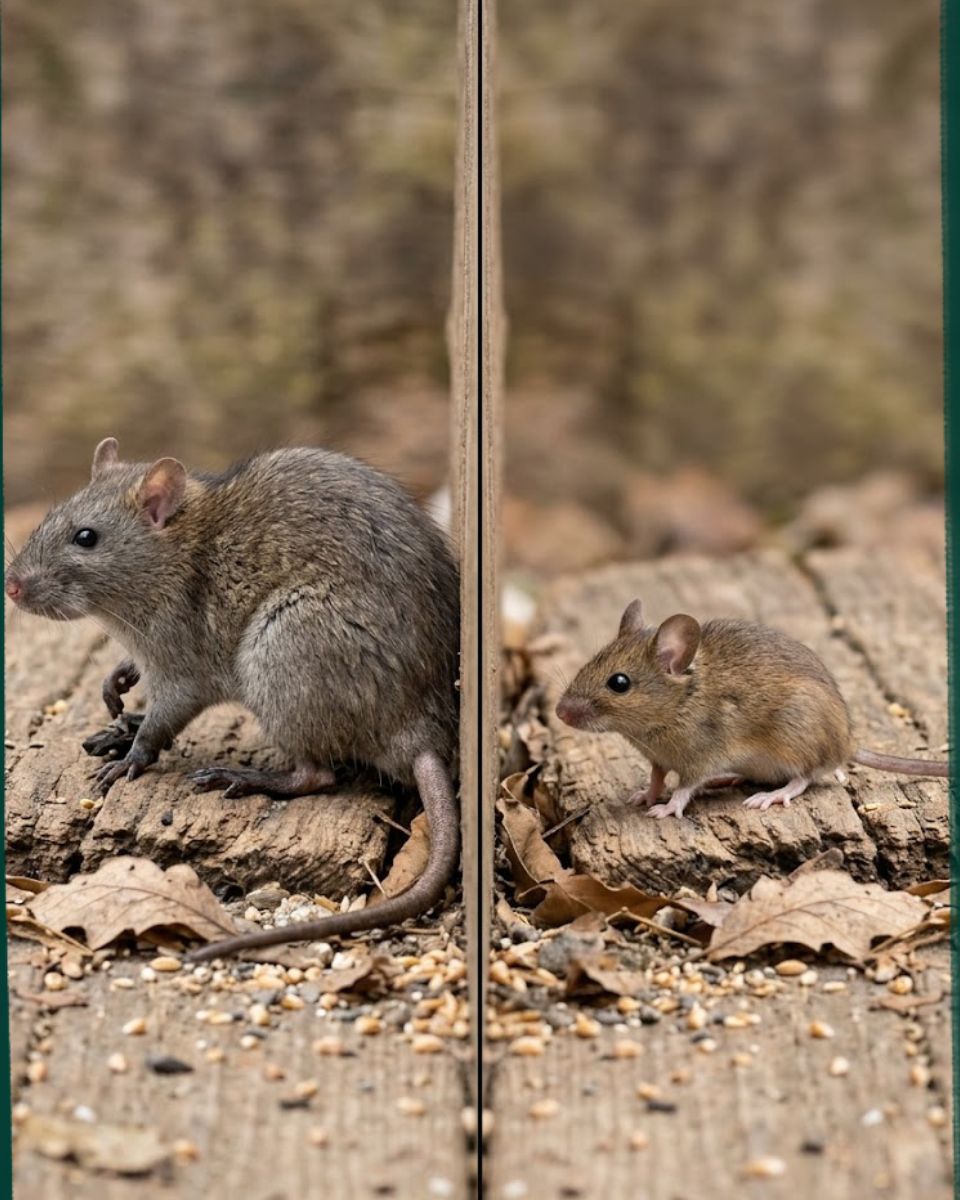
Size and physical differences
House mice are small — adults reach 5–7 inches total length including the tail, with the body itself only 2.5–4 inches. They weigh under an ounce. Coat color is typically gray-brown with lighter belly. Ears are large relative to the head. Eyes are small and bead-like.
Roof rats are mid-sized — adults reach 13–17 inches total length, with the tail noticeably longer than the body. They weigh 5–10 ounces. Coat is dark gray to black with lighter belly. Build is slender and athletic. Nose is pointed. Ears are large and somewhat translucent. Eyes are prominent.
Norway rats are the largest — adults reach 12–18 inches total length, with a tail shorter than the body. They weigh 10–18 ounces (sometimes more). Coat is brown to grayish-brown. Build is thick and stocky. Nose is blunt. Ears are small relative to head size. Eyes are smaller and less prominent than roof rat eyes.
If you see one and it looks ‘cute’ and small, it’s probably a mouse. If it looks athletic and dark with a long tail, probably a roof rat. If it looks chunky and brown, probably a Norway rat.
Behavior and habitat
House mice are exploratory and curious — they investigate new objects readily, which is why snap traps work reasonably well on them. They have small home ranges (typically 10–30 feet from nesting site) and stay near food sources. They’re comfortable in finished living spaces, walls, drawers, and pantries.
Roof rats are cautious and habit-driven — they avoid new objects for days or weeks before approaching, which is why trapping them takes patience and pre-baiting. They’re strong climbers and prefer overhead routes — attics, upper floors, tree canopies, utility lines. They rarely come down to ground level in established buildings.
Norway rats are also cautious and habit-driven but operate at ground level — basements, crawl spaces, sewers, exterior burrows. They’re strong swimmers and frequently move through sewer systems between properties. Their home range is larger than roof rats’ (50–150 feet typically).
Why species ID changes treatment scope
Mouse work focuses on interior penetrations — sealing the small gaps mice use to enter and travel through homes. Sill plates, plumbing penetrations, utility entries, dryer vent gaps, garage transitions. The scope is interior-heavy and the materials are typically straightforward (copper mesh, hardware cloth, expanding foam in non-visible locations). Treatment timeline is typically 2–4 weeks.
Roof rat work focuses on the roofline envelope — soffit returns, gable vents, ridge vents, dormer trim, flashing gaps, utility penetrations near the roofline. Attic trapping for active populations. Sometimes attic cleanup and insulation replacement if contamination is significant. The scope is exterior-and-attic heavy. Treatment timeline is typically 3–6 weeks.
Norway rat work focuses on ground-level exclusion — foundation gaps, crawl-space access points, utility penetrations at grade, exterior burrow management. Often combined with exterior bait station programs for properties with continuous corridor or marsh pressure. The scope is exterior-and-foundation heavy. Treatment timeline is typically 4–8 weeks because population dynamics are more complex.
Damage profiles — what each species actually does
Mice cause contamination damage (droppings throughout living areas, food storage contamination) and gnaw damage to packaging, weather stripping, and small wood elements. They occasionally chew wire insulation but at lower rates than rats. Structural damage is rare in single-mouse situations; established mouse populations over months can damage insulation and concealed wood.
Roof rats cause significant attic and upper-floor damage — chewed wire insulation (with associated fire risk), torn-apart attic insulation for nesting material, damaged HVAC ducting where they access ductwork, and structural wood damage at chronic travel routes. The damage typically accumulates over months and is often discovered well after population establishment.
Norway rats cause foundation, crawl-space, and ground-level damage — burrows under foundations and slabs, damaged plumbing and electrical at ground-level penetrations, contaminated crawl-space insulation, and damage to garage and basement storage. Their burrows can cause foundation settlement in extreme cases.
How fast each species reproduces
House mice reproduce most aggressively — breeding every 19–21 days with 5–10 pups per litter. Females reach sexual maturity at 6–8 weeks. A single breeding pair can theoretically produce 100+ descendants in a year under ideal conditions. Mouse populations expand very quickly once established.
Roof rats reproduce slightly more slowly — typically 4–6 litters per year with 5–8 pups per litter. Females reach sexual maturity at 10–12 weeks. Population growth is still substantial but slower than mice. Established attic populations of 6–10 rats are common; populations of 20+ rats indicate multi-year establishment.
Norway rats reproduce at similar rates to roof rats — 4–6 litters per year with 6–12 pups per litter. Females reach sexual maturity at 8–12 weeks. Norway rat populations expand quickly because of larger litter sizes and faster maturation, especially in food-abundant environments like restaurant corridors and ports.
When you might have both — mixed infestations
Properties in canopy-heavy neighborhoods with marsh proximity or commercial corridor pressure sometimes face both roof rats and Norway rats simultaneously. Coffee Bluff, Isle of Hope, Wilmington Island, and similar areas commonly have both. Treatment scope in mixed-species situations addresses both vectors — roofline exclusion plus foundation work, attic trapping plus exterior stations.
House mice frequently coexist with both rat species, particularly in older homes with multiple entry-point types. Mouse-proofing of interior penetrations is often part of broader rat-focused treatment scope rather than a separate program.
Why misidentification leads to wasted work
The most common misidentification pattern in Savannah: homeowners assume attic activity is ‘rats’ generically and seek treatment without distinguishing roof rats from Norway rats or rats from mice. Generic treatment then misses important detail. A homeowner with roof rats who hires Norway-rat-style ground-level exclusion gets clean foundation work but continues to face active attic populations. A homeowner with mice who hires aggressive rat-style treatment pays for unnecessary scope without solving the problem.
Professional inspection identifies the species during the first visit, before treatment scope is set. The 30 minutes spent on species identification saves weeks of mis-targeted treatment and significant cost. If your provider doesn’t confirm species during inspection, that’s a flag.
Dropping identification — size, shape, and location tell the story
Droppings are often the first evidence of rodent activity and the most reliable species indicator before you ever see the animal itself. Norway rat droppings are 18–20mm long, blunt at both ends, and roughly the shape of a capsule — think of a small olive. They tend to concentrate near ground-level areas: crawl spaces, behind appliances, along garage floor edges, and near food sources at ground level.
Roof rat droppings are 12–13mm, slender, and pointed at both ends — spindle-shaped. You’ll find them in elevated locations: along attic rafters, on top of wall plates, in drop ceilings, inside stored boxes stacked on shelves. The location is as diagnostic as the size.
House mouse droppings are tiny — 3–6mm, rod-shaped with pointed ends, scattered widely rather than concentrated. Mice produce 40–100 droppings daily and don’t use fixed latrine areas the way rats do, so you find them distributed across large areas. A kitchen infested with mice will have droppings in seemingly random locations across multiple drawers and cabinets.
Night sounds — what you’re hearing and what it means
Roof rats are the noisiest rodent in Savannah attics. They’re active primarily at dusk and dawn, and their movement sounds in attic spaces are characterized by rapid scurrying, thumping (they’re surprisingly large and heavy), and occasionally the sound of them dropping onto attic insulation from rafters. The classic roof rat sound is a series of quick runs across the ceiling above a bedroom, starting around 10–11 PM.
Norway rats tend to produce lower-frequency scratching and burrowing sounds, typically from below — crawl spaces, wall bases, and exterior burrow areas. If you hear grinding or gnawing sounds from wall cavities near floor level, Norway rat is the more likely candidate.
House mice produce light, high-pitched scratching sounds — sometimes described as a rustling or skittering. They’re active throughout the night rather than concentrated at dusk and dawn, and their sounds tend to come from inside walls, inside cabinets, and behind appliances rather than from overhead. If the scratching is faint enough that you only notice it in a quiet room, you’re probably hearing mice rather than rats.
How long treatment takes to work — and what that timeline looks like
House mouse treatment is typically the fastest to resolve. A correctly executed snap-trap program in a moderately infested home will show measurable activity reduction within 3–5 days. Most mouse infestations are cleared to zero activity within 10–14 days of treatment when combined with exclusion sealing of the entry points identified during inspection.
Norway rat treatment takes longer — typically 14–21 days to collapse an active population. Norway rats are neophobic (they avoid new objects in their environment) and typically won’t approach freshly set traps for 3–7 days. Bait stations with rodenticide take 4–7 days after first ingestion to produce mortality. A full program cycle from inspection to cleared status is commonly 3–4 weeks.
Roof rat treatment timeline falls between the two. Roof rats are less neophobic than Norway rats but more cautious than house mice — they typically approach new traps within 2–4 days. Attic infestations with established populations generally take 2–3 weeks to resolve fully, with the follow-up visit at 10–14 days providing critical verification data.
Cost difference between rat and mouse programs — what to expect
House mouse programs are consistently the least expensive of the three. A typical single-family residential mouse program in Savannah runs $250–$900 depending on infestation scale and whether exclusion work is included. Mouse-specific exclusion (sealing the 6mm gaps they exploit) is less labor-intensive than rat exclusion, which reduces total cost.
Norway rat programs run significantly higher — $500–$2,200 for residential work — because Norway rats are larger, more destructive, require tamper-resistant exterior bait stations (which are more expensive to install than interior snap traps), and often involve crawl space or foundation exclusion work that is physically demanding and time-consuming.
Roof rat programs land in the middle — $350–$1,800 for residential — though attic cleanup and re-exclusion work can push this higher. The attic access required for roof rat exclusion adds labor cost, and historic homes with complex rooflines require more time and more expensive materials (copper mesh vs. standard hardware cloth) to seal correctly.
Which species is harder to eliminate — and why
Norway rats are the most difficult to fully eliminate from a Savannah property. Their neophobia (avoidance of new objects) means traps sit untouched for days. Their connection to the broader port and sewer corridor means that even a successful clearance can be followed by reinfestation from exterior pressure within weeks if exclusion is incomplete. Norway rat programs require the most comprehensive exclusion and the longest monitoring period.
Roof rats are moderately difficult — more trap-shy than mice, but less so than Norway rats. The biggest challenge with roof rats in Savannah is the attic access complexity: historic homes with irregular rooflines have more entry points than a technician can find in a single inspection, and gaps missed on the first pass allow recolonization.
House mice are the easiest to clear in terms of individual animal behavior — they approach traps readily, are less cautious than rats, and respond quickly to treatment. The challenge with mice is scale: a well-established mouse population in a Savannah home can exceed 50 individuals, and at 40–100 droppings per mouse per day, the contamination cleanup scope becomes significant even after the live population is cleared.
Need help with rodents in Savannah?
Same-day inspection, locally owned, 90-day exclusion warranty across Chatham, Effingham, Bryan, and Liberty Counties.
📞 Call (912) 305-0115Related reading and services
Related blog posts: ultimate 2026 guide · infestation signs · attic and crawl space guide.
Related services: rat control · mice control · species inspection.